
Explore the Paradigm
The relational view of performance, its evolutionary foundations, and the four design mechanisms.
Why a new economic paradigm
We are living through a period of overlapping challenges: climate change, geopolitical tension, rising inequality, declining trust in institutions, social fragmentation. At first glance these appear unrelated. A closer look reveals a common pattern: they are failures of collective performance, produced by a way of organizing performance that optimizes individuals and undermines cooperation.
A paradigm is not an invention. It is a view of how the world works. For centuries, navigators planned routes on the assumption that the earth was flat. The earth was always a globe; once the more accurate model was accepted, navigation improved dramatically.
This shift is not cosmetic, and it is not a wellbeing program. It concerns where economic performance comes from: how we compete, how we work together, and what our organizations can achieve. In the prosocial paradigm, wellbeing and sustainability are part of what performance means, not a substitute for it.
The same holds for economic paradigms. We have assumed that performance is created through individual optimization. Once the lens changes, we see that something else has been driving performance all along, and we begin to act differently. Economic ideas do not merely describe reality; they shape how institutions are designed, how organizations are structured and which behaviors are rewarded.
The old and the new lens
The old paradigm assumes that people are self-interested individuals and that performance comes from optimizing them one by one: individual targets, rankings and incentives, with the planetary level left out of the equation.
The new paradigm recognizes that performance emerges from relationships and cooperation. The task of management becomes creating the conditions under which groups perform, aligned across the individual, the organization and the planet. The full comparison of the two paradigms lives on the Research page.
Performance is relational
Everything we create builds on the work of others, and our work becomes part of what others create. Performance therefore arises from relationships: between individuals, within and between teams, and between organizations and their stakeholders.
Three levels need to be aligned: the individual, the organization and the planet. Today, people are asked to optimize for themselves or for their organization, while the planetary level is left out. Prosocial performance means performing well on all three levels at once.
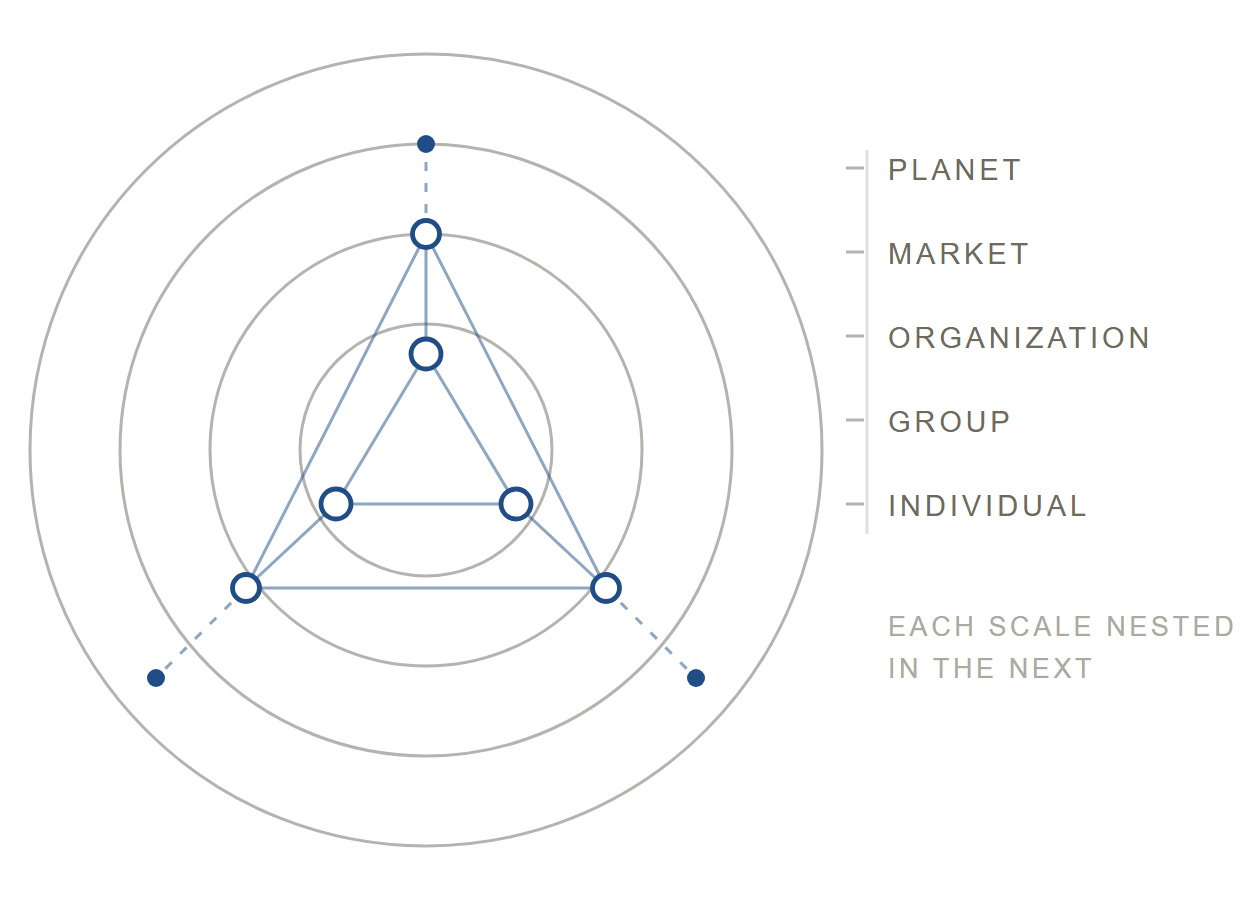
The relational field. Performance as a property of the system of relationships, read at every scale from individual to planet.
Performance management: the most powerful lever
Performance management shapes relationships inside organizations. It defines what is expected, what is measured and what is rewarded. It can make people compete against each other in fear, or it can create groups that take ownership of a shared mission.
That is why performance management sits at the core of the economic paradigm expressed in an organization, and why it is the most powerful lever for changing organizations and markets.

This is about economic performance, achieved in a better way: performance that comes together with sustainability, health and wellbeing, because people work naturally together.
Evolutionary foundations
Humans have always survived in groups. Evolutionary science shows that within groups, selfishness can beat altruism, but groups of cooperators outperform groups dominated by self-interest.
Rather than asking only how to motivate individuals, the question becomes: how can we create the relational conditions under which cooperation becomes the most effective way for actors to perform?
This logic is not limited to biology. Cultural evolutionary theory, advanced by David Sloan Wilson and colleagues, applies it to how cultures, organizations and markets develop. Evolution is the natural foundation for this paradigm because it is about survival, and because it shows that we can become active participants in how our own cultures evolve.
Four design mechanisms
Distilled from Elinor Ostrom's core design principles, four mechanisms describe how cooperation is embedded structurally rather than left to leadership intent or individual goodwill: shared purpose and identity, group self-regulation, group self-governance, and multi-level alignment.
All four need to be in place. When they are, a group can regulate itself: members keep each other behind the mission, opportunism cannot take hold, and the mission stays aligned with the bigger picture. Conventional performance management often undermines these mechanisms without anyone intending it. That is why the paradigm uses them as a relational diagnostic.
Shared purpose and identity
Purpose is a lived identity, not a slogan. It aligns actors around a common direction and extends beyond profitability to include the social and ecological systems on which the organization depends.
Underlying principle
CDP 1: Strong group identity and purpose
Group self-regulation
Teams regulate themselves through equity in how benefits and costs are distributed, inclusive participation, transparency of actions and outcomes, recognition of prosocial contributions and proportionate responses to opportunism, and accessible conflict resolution.
Underlying principle
CDPs 2 to 6: Equitable distribution, inclusive decision-making, transparent monitoring, proportionate responses, constructive conflict resolution
Group self-governance
Decision authority rests at the level closest to the work, within clear norms and guardrails. Teams have the autonomy to organize their own cooperation; accountability remains visible and shared.
Underlying principle
CDP 7: Authority to self-govern
Multi-level alignment
Purpose, identity, and self-regulation are aligned across teams, units, and partnerships, and, for platform-based and ecosystem models, across partners, suppliers, regulators, and communities.
Underlying principle
CDP 8: Nested governance
From organizations to markets
Organizations adopt different models of organizing performance. Some continue to optimize individuals; others begin to design for relational quality.
Prosocial performance cultures prove more resilient, healthier and economically stronger. They attract the best people and earn the trust of stakeholders. Markets and societies begin to favor them.
What works is kept, copied and passed on. Prosocial designs spread across organizations and industries, and gradually change what markets reward.
Competition is not eliminated. It is refined. Markets compete not on efficiency or scale alone, but on the capacity to create and sustain the relational conditions under which cooperation thrives.
Everybody has a role
A shift like this is not made by one actor. Different perspectives are needed, and everybody has a role to play. Executives can lead the change in their organizations. Researchers can explore the paradigm and change the narrative in research. Educators can prepare the next generation of decision makers.
Build teams and organizations that perform better.
How to diagnose it in your own team or organization: the framework, the four mechanisms as a relational diagnostic, and the implications for practice.
The foundations of the paradigm.
The foundational paper, its grounding in evolutionary science and institutional governance, and how the paradigm sits alongside adjacent approaches.
Teach the next economic paradigm.
What we teach the next generation matters: steps and materials for bringing the paradigm into the classroom, across business subjects.